
Ofc Poker Fantasyland
- Ofc Poker Fantasyland Poker
- Ofc Poker Fantasyland Club
- Ofc Poker Forum
- Ofc Poker Fantasyland Movie
- Open Face Chinese Poker Strategy Fantasyland
- Ofc Poker Fantasyland Tour
If a poker player manages to set a pair of Queens or better in the top and manages not to foul, they enter fantasyland as per OFC poker rules. Following the OFC poker rules, a player is dealt with 14-17 cards in one go after qualifying for fantasy land. No contest, this puts you at a great advantage. Jan 31, 2017 The OFC Fantasyland Calculator is a mobile app available on any iOS device. The app is a tool to help its users play better Open-face Chinese Poker (OFC for short), a skill based card game popular among poker enthusiasts. The app helps its users play OFC better by solving a portion of the game called Fantasyland. Welcome to my personal blog on OFC Pineapple (Open Face Chinese Poker). Week after week, I’ll go over the history of the game, some basic rules and recommendations, anecdotes from the players, and finally, some more advanced strategies. Stay tune and enjoy the Fantasy Ride!
Welcome back open-face Chinese poker fans! Happy to be writing this third part of my own little OFC guide! So far we’ve discussed the history of Chinese poker, the appearance and popularity of the open-face format, and how the game is scored including royalties.
Since OFC was first introduced, the game has been in non-stop evolution, with variations on the classic OFC game being introduced.
Three of those variations: “Pineapple,”“Progressive,” and “Deuce-to-Seven” will the be topics of this part of my guide. I'll discuss the 'Turbo' variation in details in a later column.
Pineapple OFC
These days “Pineapple OFC Fantasyland” is the most popular and well-known form of the game.
In this variation, the number of players is limited to three rather than four. This is because after the initial five cards are dealt and placed by the players, they subsequently receive not one card at a time (as in traditional OFC), but three cards each round, from which they have to position two and discard one. That difference also means that unlike in a four-handed game of traditional OFC, not all the cards in the deck ultimately will be visible to the players. Nevertheless, counting outs remains super important!
Even more fundamental and strategy-influencing is another big difference introduced in Pineapple OFC. When you successfully place a pair of queens or better on the top line (without fouling, obviously), you gain access to what we call “Fantasyland” which means that for the following hand you will receive all your cards at once, affording you the luxury of placing them wherever you want on your board.
More precisely, you will receive a total of 14 cards and you will have to place 13 of them, discarding one. You’ll have the absolute certainty of not fouling that hand, (unless you make a mistake in placing your cards LOL)! Therefore the game involves focusing not just on avoiding fouling and beating your opponents’ lines, but also on trying to make at least a pair of queens on top in order to get to Fantasyland!
Pineapple Progressive OFC
As for the “Progressive” variation of OFC, it involves a different type of Fantasyland, which I think is very well adapted, and will most probably become the new standard of the game.
In Progressive OFC, when you successfully place a pair of queens on top, you get 14 cards on the next hand, just like in the Pineapple variation. But when you place a pair of kings on top, you’ll get 15 cards on the next hand; when you place a pair of aces on top, you’ll get 16 cards on the next hand; and when you place trips on top, you’ll get 17 cards on the next hand!
Wow... talk about an advantage! To be able to see 17 cards and place 13 however you want, you can just imagine all the crazy hands you can make and enormous royalties you can collect with those!
I love this variation of the game. For one thing, the small pair on top that had huge value in the original closed Chinese Poker game loses much of its potential in Pineapple OFC, where the goal is always to put a pair of queens or higher on top. However in Progressive OFC, this very same small pair can turn into trips and regain its usefulness thanks to the 17-cards reward that comes along with it in Fantasyland!
In fact, I had a long discussion with Bruno “King” Fitoussi and we are not sure at all that being in Fantasyland with 14 cards is so much of an advantage. Admittedly, you have the absolute certainty of not fouling, which is definitely a non-negligible edge. But very often you’ll find yourself making a hand without huge potential, something like a straight in the back, a pair in the middle, and ace on top, which perhaps diminishes the advantage somewhat.
Meanwhile when you’re not in Fantasyland, you have access to a total of 17 cards (the five initial cards, then 4 x 3 cards from which you’ll place two each time to total 13). Even though busting out will be relatively frequent, it will also be frequent to make enormous hands and sick bonuses!
At the end of the discussion, we agreed that we should call Paul “X-22” Magriel so that he could make some incomprehensible crazy genius mathematical calculations to finally give us a final answer on the question (LOL)! But one thing we categorically agreed on is that if you can get to Fantasyland with 15 cards in Progressive OFC, the answer is 100% clear: it’s definitely a huge advantage over not being in Fantasyland!
My forecast is that OFC Progressive is the absolute realization of this game, and that it is here to stay. I’m very motivated to become an expert in this variation that I am so passionate about!
Pineapple Deuce-to-Seven OFC
That being said, I’m just as captivated (or maybe more) by the “Deuce-to-Seven” variation of OFC where in the end you’ll get to Fantasyland way more frequently. Here, just as in regular OFC, the bottom line has to be the strongest of your board. However, the middle line is played in deuce-to-seven format, meaning that the best possible hand (23457 in different suits) is accompanied by a bonus and also taking you to Fantasyland.
In this variation, you can also get to Fantasyland with the top line, but here you will need a pair of kings or better to do so. And the one thing that can drive you absolutely crazy in Deuce-to-Seven OFC is actually being in Fantasyland and still busting out, because you can’t find five cards under 10 that are not making a straight or a flush. It happens only rarely, but it feels just like a bad beat!
In all three variations of OFC: Pineapple, Progressive, and Deuce-to-Seven, the same rules apply in order to return to Fantasyland when you are already there, but we’ll discuss that later.
Test yourself at the game by downloading TonyBetPoker and use deposit code 'NOMERCY' to receive 100% bonus up to €500, and a free ticket entry to play with me
in my weekly OFC 'Progressive' Signature event on Wednesday Nights!
See you at the tables!
This month I’ve been teaching myself how to play Crazy Pineapple Open Face Chinese Poker with Fantasyland. It is an awesome game, but needs a new name. For now, we’ll call it “OFC.”
Using Corvid’s OFC Poker app on my iPad ($5.99), anyone with an iPad or iPhone (I suspect this is also available for other smart device formats – Samsung, Droid, whatever…) can play OFC with friends, in much the same manner of Words With Friends and similar games. The app does not accept deposits or settle up monetary bets.
OFC is designed for 2 players, although it can be played with 3 players. Leave out the Crazy Pineapple part, and 4 players can play. But never more than that. The OFC app is set up for 2 players only (if there is a setting to add a 3rd player, I haven’t discovered it yet). In this game, players take turns, so when it is your turn, the app simply waits for you to act. When you do, your opponent gets a prompt that the action is now on him or her.
How to play, you might ask?
OFC is built on traditional Chinese Poker. In traditional Chinese poker, each player is dealt 13 cards. You then organize the cards into 3 poker hands: Two 5-card hands, and one 3-card hand. The 3-card hand is placed on the table above (or in front of) one of the 5-card hands, which is placed above the other 5-card hand. There is a requirement for the bottom hand to be the strongest, followed by the middle hand, with the top hand being the weakest. No straights or flushes can count for the top hand since it only has 3 cards. So an arrangement might look like this:
Top 8d 8c 3s One pair of eights
Middle Ts 9d Tc 9s Kd Two pair, tens and nines
Ofc Poker Fantasyland Poker
Bottom Ah Kh Jh 4h 2h Flush, ace high
Next, you compare your top hand to your opponents top hand, middle v. middle and bottom v. bottom. Whoever has the strongest hand on each row wins one “point” for that row.
If real money is involved (this is poker, after all), each point has an agreed upon monetary value. While at the WSOP this summer, I saw OFC being played in the cash games area for $10 per point and higher.
Next, you determine whether any bonus (or “royalty”) points have been won. If you win all three rows, in addition to 3 points, you also get a bonus of 3 more points for scooping. There are also bonuses based on hand strength. The minimum requirement is a straight on the bottom (worth 2 bonus points), or three of a kind in the middle (worth 2 points), or a pair of sixes on the top (worth 1 point). In my sample hand above, the flush on the bottom is worth 4 bonus points, and the pair of eights on the top is worth 3 bonus points.
Notice that I could have arranged these cards differently, with two pair of nines and eights in the middle and one pair of tens at the top. The pair of tens would be worth 5 bonus points, so that would be a more profitable play.
If the top hand is stronger than the middle, or the middle is stronger than the bottom, your entire hand is “foul” (a/k/a “misset” or simply disqualified) and you are not eligible to win ANY points on the hand regardless of the strength of any individual row.
Got it? That’s just traditional Chinese Poker. Now for the Open Face part.
In OFC, each player is dealt 5 cards and takes turns setting these initial cards in the 3 rows. It might look like this:
Ofc Poker Fantasyland Club
Top 2c Useless card
Middle 7d 7h Setting a pair
Bottom Qs Js 9s Setting up for a flush or straight
Once a card is placed at the top/middle/bottom, it cannot be later moved to another row. OFC is a button game, so the player with the dealer button acts last, and has the benefit of seeing the opponent’s first 5 cards before acting. In the example above, if I had the button and my opponent showed 4 spades in his arrangement, I might try a different strategy instead of going for a flush on the bottom.
Ofc Poker Forum
Then each player is dealt one card at a time, in sequence (button still last to act), and places each card in one of the rows to try to score the most points. After the first 5 cards are set, back and forth you go for 8 more cards, one at a time, until all 13 have been set. There are 3 simultaneous equations to solve here: 1) not fouling the hand, by making sure the bottom beats the middle, which beats the top; 2) having enough strength in each row to beat the opponent’s corresponding row; and 3) winning bonus/royalty points. Here is a good article with full details of bonus/royalty scoring.
Got it? But wait, there’s more. Whenever the top hand is QQ or higher (QQ earns 7 bonus points, and the hand is not fouled, you get to go to “Fantasyland.” This simply means that on the next hand, you get all 13 cards at once (like traditional Chinese Poker) and have complete information to use in arranging your 3 rows. Not only is there no risk of fouling your hand, but you never miss out on a huge hand like quads or a straight flush by splitting these up into different rows early in the hand. When you finish arranging the hand, you place all of the cards face down in their respective rows, so your opponent has no knowledge of which cards he might need to complete his rows are already dead. To your opponent, your hand looks like this:
Top x x x

Middle x x x x x
Bottom x x x x x
Ofc Poker Fantasyland Movie
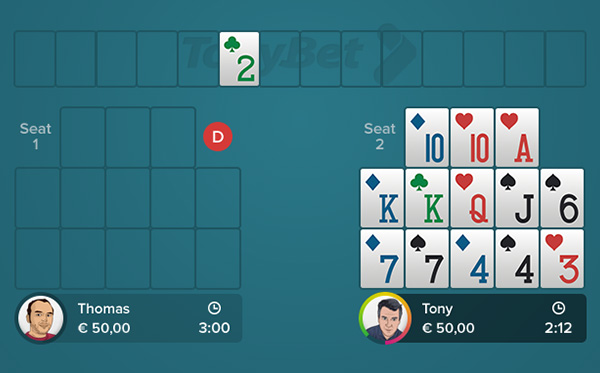
Obviously, going to Fantasyland is a huge benefit. But there is also a lot of risk of fouling the entire hand, if for example your first five cards include two Kings, and you decide to place them on the top row prior to having stronger hands in the middle and bottom. Gulp!
Got it? But wait, so far I’ve only covered OFC with Fantasyland. What about Crazy Pineapple?
In the Crazy Pineapple version, after the first 5 cards are set, each player is dealt 3 cards at a time. When it is your turn, you set 2 of 3 on the board, selecting the optimal row, and the 3rd card is discarded. Instead of 9 turns per player to complete a hand (initial 5 cards, then 8 turns with 1 card at a time), it only takes 5 turns per player (initial 5 cards, then 4 turns of setting 2 cards and discarding 1). This speeds up the game. Crazy Pineapple also gives you more total cards to choose from, resulting in more bonus points and trips to Fantasyland, making this the most popular version of the game for high rollers and gamblers. Since your opponent is looking at more total cards, when you do get to Fantasyland in the Crazy Pineapple version, you get dealt 14 cards instead of 13, and sometimes that last card is just what you need to score extra points.
Open Face Chinese Poker Strategy Fantasyland
Thus the final full name: “Crazy Pineapple Open Face Chinese Poker, with Fantasyland.”
About that name… it is hilarious when I mention this game to some of my poker-addicted friends. They screw their faces all up and say, oh my gosh, I could never learn a game as complicated as “Crazy Fantasy Island Open Face, Closed Mouth, Ancient Chinese Parcheesi Poker with a Twist” or whatever that was you just said. It’s just too complicated. This reaction comes before they even hear how the game is played.
Now that I’ve played a few dozen games, I can tell you dear readers, this game is not really so complicated. The mechanics are actually pretty straightforward: make 3 hands of progressive strength, then compare to your opponent’s 3 hands.
What is needed is a simpler name. When you first heard of Texas Hold’em or Omaha, surely that didn’t sound as difficult as building the entire Great Wall of China. I think I’m going to try “Open Face” as a short-hand name. Regular OFC players tend to fall back on the 3-letter acronym (“TLA”) OFC, but I’m not a big fan of TLAs in the first place. I mean, WTF, some people have trouble deciphering the acronyms, and the short-hand becomes a big WOT (waste of time) when you could have gotten TTP (to the point) by simply pronouncing the words rather than the letters. OMG. Let’s rein in the acronyms. LOL.
If you want to try some Open Face with me, for fun or money, download this app on your smart device. My ID is KKing David. I’m currently playing with 3 friends for $0.10 per point. The app sets up a game as 20 hands in the Crazy Pineapple version, or 10 hands of the regular OFC version, but this appears to be an arbitrary cutoff. In a live, casino OFC game, the loser of each hand would pass chips to the winner based on the net points for that hand. Since the app doesn’t facilitate the exchange of money, settling up after each batch of 20 hands makes sense. So far the largest scores have been about 100 points over a game of 20 hands, which at $0.10 per point is ten bucks.
Ofc Poker Fantasyland Tour
Hopefully more posts to follow exploring some of the strategic and tactical issues, which I am still very much in the infancy of learning.