
Probability Of Hands In Texas Holdem
When we are dealt a hand in Texas Hold'em, we don't care whether we get the A first or the K first (which is what we just worked out), just as long as we get them in our hand it's all the same. There are two possible combinations of being dealt this hand (A K and K A ), so we simply multiply the probability by 2 to get a more useful probability. The Texas Hold’em odds of how likely hands are to unfold after the flop will help guide almost every action you make on the flop Odds On the Flop in Texas Hold’em. The flop is the turning point of a Hold’em hand. This is where you’re going to make your biggest and most expensive decisions. In Texas Hold'em, poker odds are THE probability tool you need as a poker player. In fact, you should always be thinking about poker odds - yours and your opponents' - when making decisions. In short, poker odds is the probability of you winning that hand, or the price it offers (pot odds).
Both before and after the flop in any limit Holdem game, it is helpful to be able to make a reasonably accurate estimate of the types and numbers of playable hands that you are likely to be competing against.
Probability Of Hands In Texas Holdem
Much of your decision making involves the business of 'putting' opposing players 'on their hands' (or in other words, figuring out what cards they are playing). Experienced Holdem players are often very good at this. An understanding of the types of hands that are most likely to be against you helps prevent both underestimating and overestimating your competition.
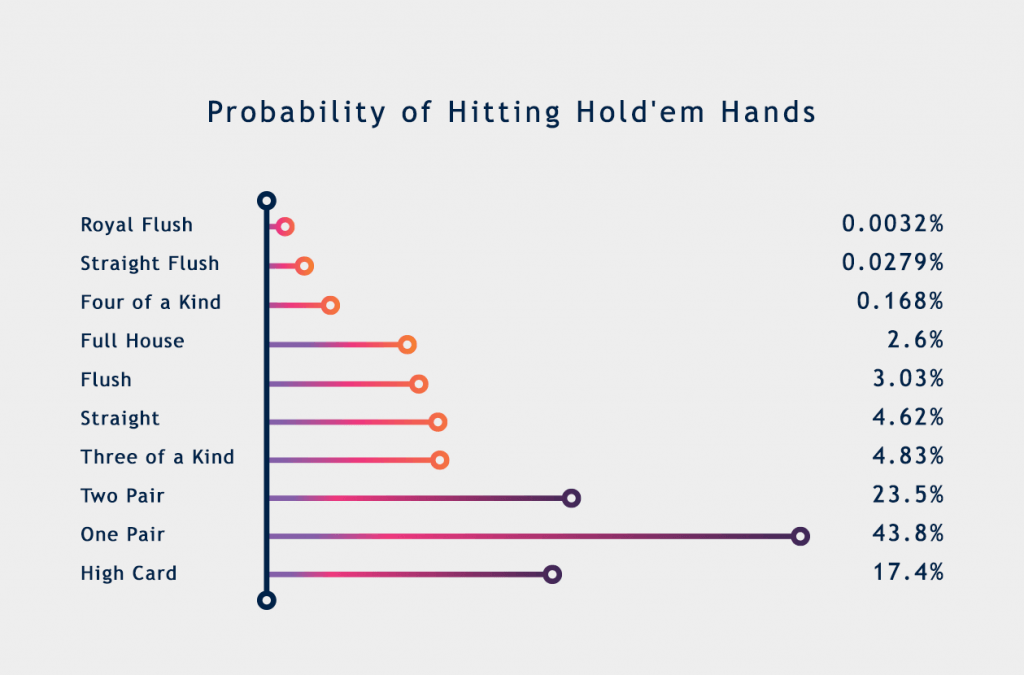
Here are some stats that are based on the total possible combinations of various Holdem hole cards that are normally playable.
For better viewing on your mobile device (or to download or print the chart), check out holdem hole card frequencies in high resolution universal .pdf format.
The five different types of two card Hold'em hands highlighted here are those that are most commonly played. They are not shown in any particular order and within the groups are powerful hands that are almost always played, down to marginal value hands that can be played under certain betting conditions.
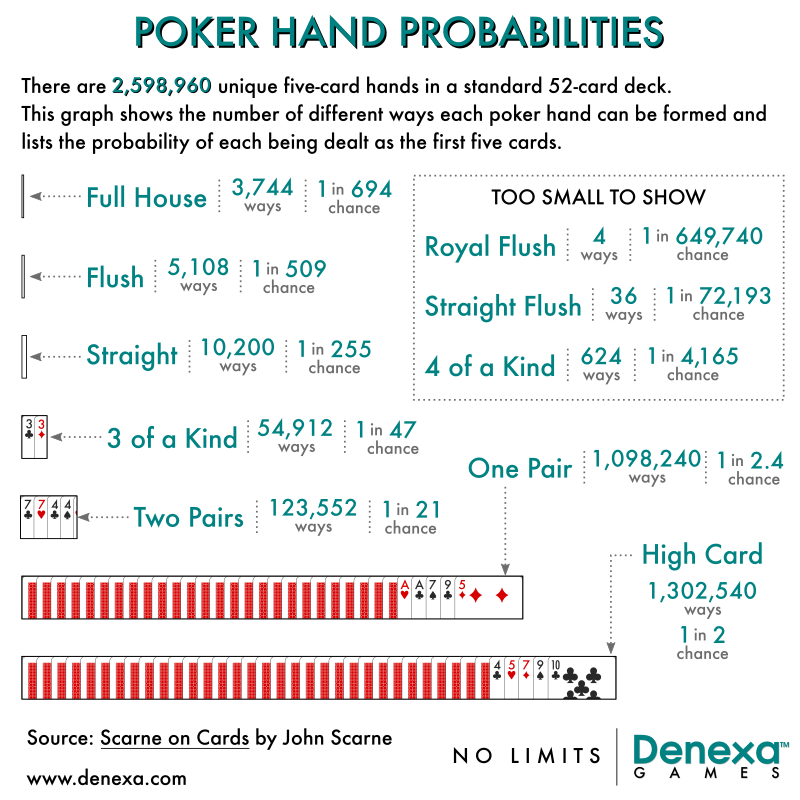
The rest of the hands, shown as All Others, are all the very weak hands that most players hardly ever play.

Pairs - All pairs. AA, KK, QQ, JJ, 1010, 99, 88, 77, 66, 55, 44, 33, 22
Two High Cards Suited - AK(S), AQ(S), AJ(S), A10(S), KQ(S), KJ(S), K10(S), QJ(S), Q10(S), J10(S)
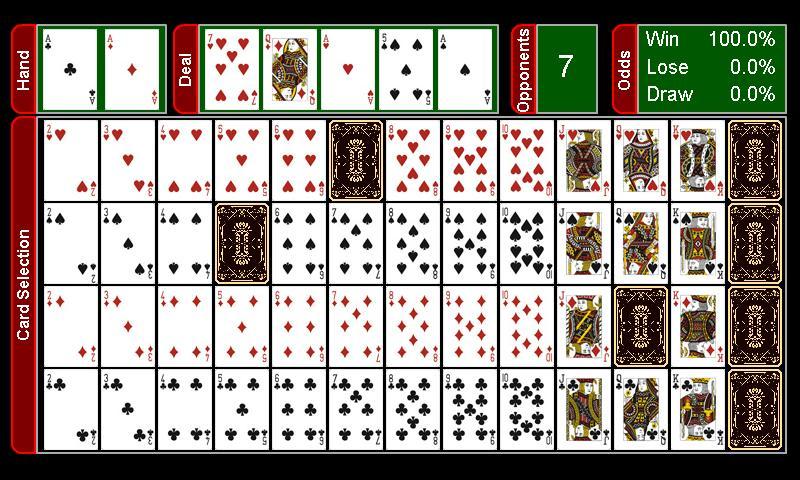
Two High Cards Unsuited - AK, AQ, AJ, A10, KQ, KJ, K10, QJ, Q10, J10
Probability Of Winning Hands In Texas Holdem
Medium and Low Suited Connectors - These include both no-gap and one-gap connectors: J9(S), 109(S), 108(S), 98(S), 97(S), 87(S), 86(S), 76(S), 75(S), 65(S), 64(S), 54(S), 53(S)
Ace and Non-High Combinations - A9, A8, A7,A6 Note: 25% of these 64 combinations (16) are suited. 75% of the 64 combinations (48) are unsuited.
Playing poker is about playing the odds. The following list gives the odds for outcomes in Texas Hold’em hands. When you realize how heavily the odds are stacked against you, you may want to rethink going all-in before the flop with two suited cards. Use the odds to your advantage:
Probability Of Hands In Texas Holdem Tournament
1 percent (1-in-100): Percentage of time that no player holds an Ace or a King at a table in a 10-handed game
1 percent (1-in-100): Percentage of time that if you hold two suited cards, you’ll flop a flush
6 percent (about 1-in-20): Percentage of time that five community cards will give pocket suited cards a flush
6 percent (about 1-in-20): Percentage of time that you’ll be dealt a pocket pair
8 percent (about 1-in-12): Percentage of time that you’ll hit at least trips after having a pair on the flop
12 percent (about 1-in-8): Percentage of time that you’ll flop trips if holding a pocket pair
12 percent (about 1-in-8): Percentage of time that two more cards will flop in the same suit as a suited pocket pair
19 percent (about 1-in-5): Percentage of time that the five community cards will at least trip your pocket pair
32 percent (about 1-in-3): Percentage of time that you’ll pair one of your cards on the flop (with no pocket pair)
33 percent (about 1-in-3): Percentage of time that you’ll make a full house or better after having trips on the flop
35 percent (about 1-in-3): Percentage of time that you’ll make a flush on the turn or river if you have four cards to a flush after the flop