
Qt Signal Slot Priority
Signals and slots were one of the distinguishing features that made Qt an exciting and innovative tool back in time. But sometimes you can teach new tricks to an old dog, and QObjects gained a new way to connect between signals and slots in Qt5, plus some extra features to connect to other functions which are not slots. The button click (signal) is connected to the action (slot). In this example, the method slotmethod will be called if the signal emits. This principle of connecting slots methods or function to a widget, applies to all widgets.
Qt5 alpha has been released. One of the features which I have been working on is a new syntax for signals and slot.This blog entry will present it.
Here is how you would connect a signal to a slot:
The connection mechanism uses a vector indexed by signals. But all the slots waste space in the vector and there are usually more slots than signals in an object. So from Qt 4.6, a new internal signal index which only includes the signal index is used. While developing with Qt, you only need to know about the absolute method index. Connecting in Qt 5. There are several ways to connect a signal in Qt 5. Qt 5 continues to support the old string-based syntax for connecting signals and slots defined in a QObject or any class that inherits from QObject (including QWidget).
What really happens behind the scenes is that the SIGNAL and SLOT macros will convert their argument to a string. Then QObject::connect() will compare those strings with the introspection data collected by the moc tool.
What's the problem with this syntax?
While working fine in general, we can identify some issues:
- No compile time check: All the checks are done at run-time by parsing the strings. That means if you do a typo in the name of the signal or the slot, it will compile but the connection will not be made, and you will only notice a warning in the standard output.
- Since it operates on the strings, the type names of the slot must match exactly the ones of the signal. And they also need to be the same in the header and in the connect statement. This means it won't work nicely if you want to use
typedefor namespaces
In the upcoming Qt5, an alternative syntax exist. The former syntax will still work. But you can now also use this new way of connecting your signals to your slots:
Which one is the more beautiful is a matter of taste. One can quickly get used to the new syntax.
So apart from the aesthetic point of view, let us go over some of the things that it brings us:
Compile-time checking
You will get a compiler error if you misspelled the signal or slot name, or if the arguments of your slot do not match those from the signal.
This might save you some time while you are doing some re-factoring and change the name or arguments of signals or slots.
An effort has been made, using static_assert to get nice compile errors if the arguments do not match or of you miss a Q_OBJECT
Arguments automatic type conversion
Not only you can now use typedef or namespaces properly, but you can also connect signalsto slots that take arguments of different types if an implicit conversion is possible
In the following example, we connect a signal that has a QString as a parameter to a slot that takes a QVariant. It works because QVariant has an implicit constructor that takes a QString
Connecting to any function
As you might have seen in the previous example, the slot was just declared as publicand not as slot. Qt will indeed call directly the function pointer of the slot, andwill not need moc introspection anymore. (It still needs it for the signal)
But what we can also do is connecting to any function or functor:
This can become very powerful when you associate that with boost or tr1::bind.
C++11 lambda expressions
Everything documented here works with the plain old C++98. But if you use compiler that supportsC++11, I really recommend you to use some of the language's new features.Lambda expressions are supportedby at least MSVC 2010, GCC 4.5, clang 3.1. For the last two, you need to pass -std=c++0x asa flag.
You can then write code like:
This allows you to write asynchronous code very easily.
Update: Also have a look what other C++11 features Qt5 offers.
It is time to try it out. Check out the alpha and start playing. Don't hesistate to report bugs.
Introduction
Remarks
Official documentation on this topic can be found here.
A Small Example
Signals and slots are used for communication between objects. The signals and slots mechanism is a central feature of Qt and probably the part that differs most from the features provided by other frameworks.
The minimal example requires a class with one signal, one slot and one connection:
counter.h
The main sets a new value. We can check how the slot is called, printing the value.
Finally, our project file:
The new Qt5 connection syntax
The conventional connect syntax that uses SIGNAL and SLOT macros works entirely at runtime, which has two drawbacks: it has some runtime overhead (resulting also in binary size overhead), and there's no compile-time correctness checking. The new syntax addresses both issues. Before checking the syntax in an example, we'd better know what happens in particular.
Let's say we are building a house and we want to connect the cables. This is exactly what connect function does. Signals and slots are the ones needing this connection. The point is if you do one connection, you need to be careful about the further overlaping connections. Whenever you connect a signal to a slot, you are trying to tell the compiler that whenever the signal was emitted, simply invoke the slot function. This is what exactly happens.
Here's a sample main.cpp:
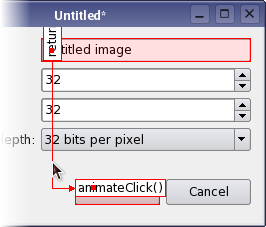
Hint: the old syntax (SIGNAL/SLOT macros) requires that the Qt metacompiler (MOC) is run for any class that has either slots or signals. From the coding standpoint that means that such classes need to have the Q_OBJECT macro (which indicates the necessity to run MOC on this class).
The new syntax, on the other hand, still requires MOC for signals to work, but not for slots. If a class only has slots and no signals, it need not have the Q_OBJECT macro and hence may not invoke the MOC, which not only reduces the final binary size but also reduces compilation time (no MOC call and no subsequent compiler call for the generated *_moc.cpp file).
Connecting overloaded signals/slots
While being better in many regards, the new connection syntax in Qt5 has one big weakness: Connecting overloaded signals and slots. In order to let the compiler resolve the overloads we need to use static_casts to member function pointers, or (starting in Qt 5.7) qOverload and friends:
Multi window signal slot connection
A simple multiwindow example using signals and slots.
There is a MainWindow class that controls the Main Window view. A second window controlled by Website class.
The two classes are connected so that when you click a button on the Website window something happens in the MainWindow (a text label is changed).
I made a simple example that is also on GitHub:
mainwindow.h
mainwindow.cpp
website.h
website.cpp
Project composition:
Consider the Uis to be composed:
- Main Window: a label called 'text' and a button called 'openButton'
- Website Window: a button called 'changeButton'
So the keypoints are the connections between signals and slots and the management of windows pointers or references.